
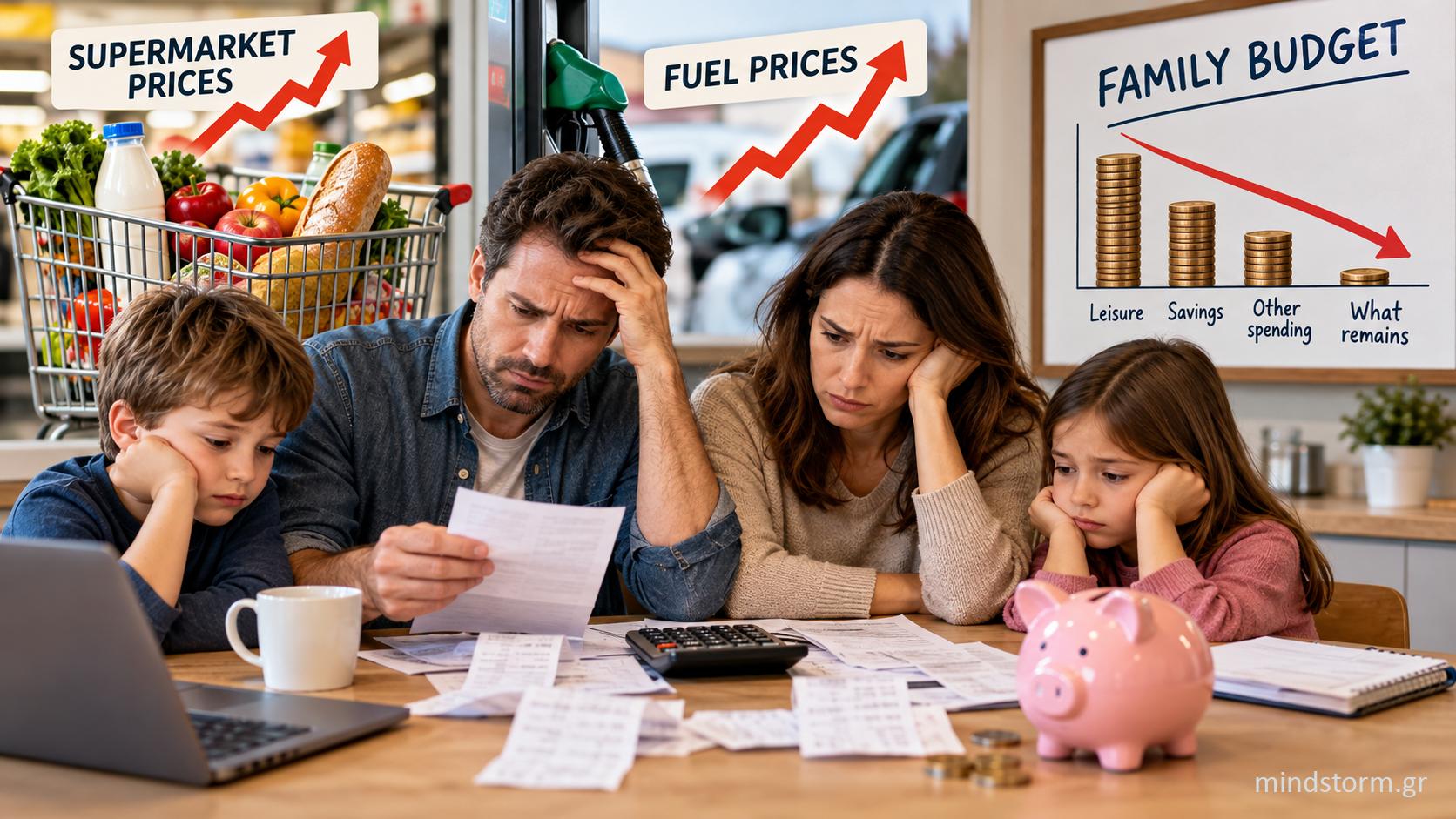
When Essential Prices Rise: What Happens to a Family Budget?
I will use a simplified monthly budget for a family of four. My purpose is to show, step by step, what happens when supermarket and energy/fuel prices rise while household income stays unchanged.
1. Starting monthly budget
| Category | Monthly amount | Type |
|---|---|---|
| Housing & utilities | €750 | Essential / mostly fixed |
| Transportation | €150 | Essential |
| Insurance | €100 | Mostly fixed |
| Debt repayments | €200 | Fixed |
| Childcare & education | €200 | Essential |
| Supermarket | €500 | Essential – affected by price rises |
| Energy & fuel | €250 | Essential – affected by price rises |
| Leisure & personal spending | €100 | Adjustable |
| Total regular spending | €2,250 | |
| Income | €2,500 | |
| Money remaining / possible savings | €250 |
The family normally spends €750 per month on the two categories examined here: €500 at the supermarket and €250 on energy and fuel. Before any price increase, €250 remains. This amount can be saved, used for unexpected costs, or spent on other family needs.
2. What if supermarket and energy/fuel prices rise?
The table assumes that the family buys approximately the same quantity of essential goods and services. Only their prices change. Income remains €2,500 per month.
| Price rise | Extra essential cost | New monthly spending | Money remaining |
|---|---|---|---|
| 5% | +€37.50 | €2,287.50 | €212.50 |
| 10% | +€75.00 | €2,325.00 | €175.00 |
| 15% | +€112.50 | €2,362.50 | €137.50 |
| 20% | +€150.00 | €2,400.00 | €100.00 |
| 25% | +€187.50 | €2,437.50 | €62.50 |
| 30% | +€225.00 | €2,475.00 | €25.00 |
| 35% | +€262.50 | €2,512.50 | −€12.50 |
| 40% | +€300.00 | €2,550.00 | −€50.00 |
3. Where does the extra money come from?
A price increase does not automatically increase the family’s income. The household therefore has to rebalance its budget. At first, it can use the €250 that previously remained. As that buffer becomes smaller, the family has fewer choices.
| Stage | Budget situation | Likely response |
|---|---|---|
| Low increase (5–10%) | €175–€212.50 remains | Smaller savings; minor reductions in optional spending. |
| Moderate increase (15–20%) | €100–€137.50 remains | More careful shopping; fewer leisure activities; purchases postponed. |
| High increase (25–30%) | Only €25–€62.50 remains | Very little room for unexpected expenses; savings almost disappear. |
| Very high increase (35–40%) | Budget is negative | Spending must be cut further, savings used, or debt/extra income considered. |
4. From prices to family relationships
The effect is not only financial. A tighter budget changes the decisions a family has to make. When there is enough money, many everyday choices can be made without conflict. When the available amount shrinks, the same family has to decide which needs or wants will be reduced.
- Supermarket and fuel prices rise.
- Essential monthly spending increases.
- Money available for savings, leisure and unexpected costs falls.
- The family must make more trade-offs and postpone some choices.
- Different priorities may become more visible: save money, maintain activities, help children, repay debt, etc.
- Repeated financial pressure can create worry, frustration or disagreement and may put strain on relationships.
Important: This does not mean that higher prices automatically cause family conflict. Financial pressure reduces flexibility and creates more decisions about competing priorities. How a family responds depends on its circumstances, communication, savings, debts and other resources.
5. Questions for discussion
- At what percentage increase does this family’s budget first become negative?
- What happens to the family’s financial safety margin between a 5% and a 30% increase?
- Which expenses would be easiest to reduce? Which would be hardest to reduce, and why?
- If the family cuts leisure spending first, how might this affect everyday family life?
- What might happen if an unexpected €150 expense occurs when prices have already risen by 30%?
- Why might two adults in the same household disagree about which expenses should be reduced?
- What could the family do besides cutting expenditure?



Comments are closed.