
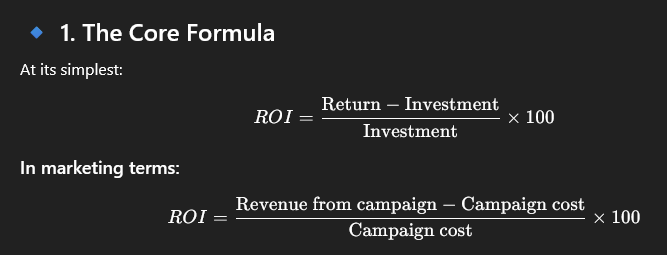
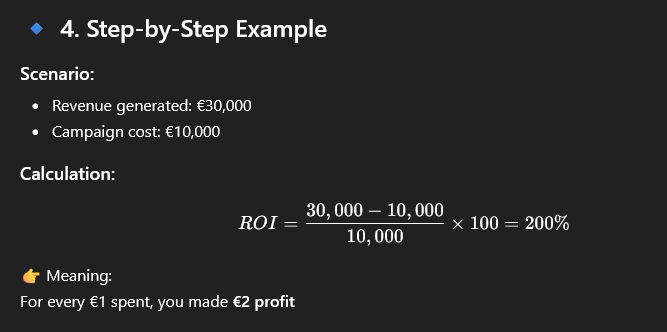
ROI in marketing isn’t complicated mathematically—but the real difficulty is defining what counts as “return” and what costs you include. I’ll break it down both formula-wise and practically.
🔹 2. What counts as “Return”?
This is where most people go wrong.
✅ Best case (ideal):
- Direct revenue from campaign conversions
Example:
- Campaign generated €50,000 in sales
⚠️ Sometimes more complex:
Depending on your setup, you might use:
- Attributed revenue (from tracking tools)
- Incremental revenue (what wouldn’t have happened without the campaign)
- Customer Lifetime Value (CLV) (if campaign brings new customers)
👉 Example with CLV:
- 100 new customers × €200 lifetime value = €20,000 return
🔹 3. What counts as “Investment”?
You need the full cost, not just ad spend.
Include:
- Ad spend (Google, Meta, etc.)
- Creative production (videos, design)
- Agency or team costs
- Tools/software (if significant)
👉 Example:
- Ads: €10,000
- Creative: €2,000
- Total cost: €12,000
🔹 6. The Real Logic (What you’re actually measuring)
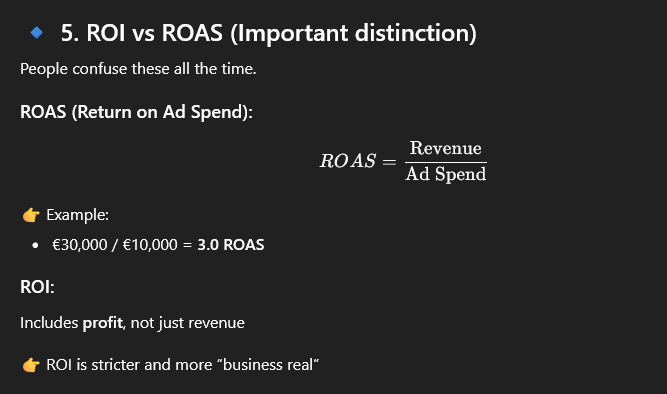
ROI answers:
“Was this campaign worth the money?”
So you’re comparing:
- What you gained
vs - What you spent to gain it
🔹 7. Advanced Thinking (what makes you stand out)
Good marketers don’t just calculate ROI — they question it:
🔸 Attribution problem
- Was the sale really from the campaign?
- Or would it happen anyway?
🔸 Time lag
- Campaign today → revenue next month
🔸 Brand campaigns
- Awareness doesn’t convert immediately
👉 In those cases, ROI is:
- harder to measure
- sometimes underestimated
🔹 8. Clean way to explain it in an interview
If you had to say it simply:
“To calculate ROI, I compare the revenue generated by the campaign to its total cost. I subtract the investment from the return to get the net profit, divide by the cost, and express it as a percentage. I also ensure that the revenue is properly attributed and, when relevant, I consider customer lifetime value to get a more accurate picture of long-term impact.”
🔥 Final takeaway
ROI is not just a formula—it’s a decision tool.
👉 A “good” ROI means:
- You created more value than you spent
👉 A “bad” ROI means:
- Your strategy, targeting, or channels need fixing


Comments are closed.