
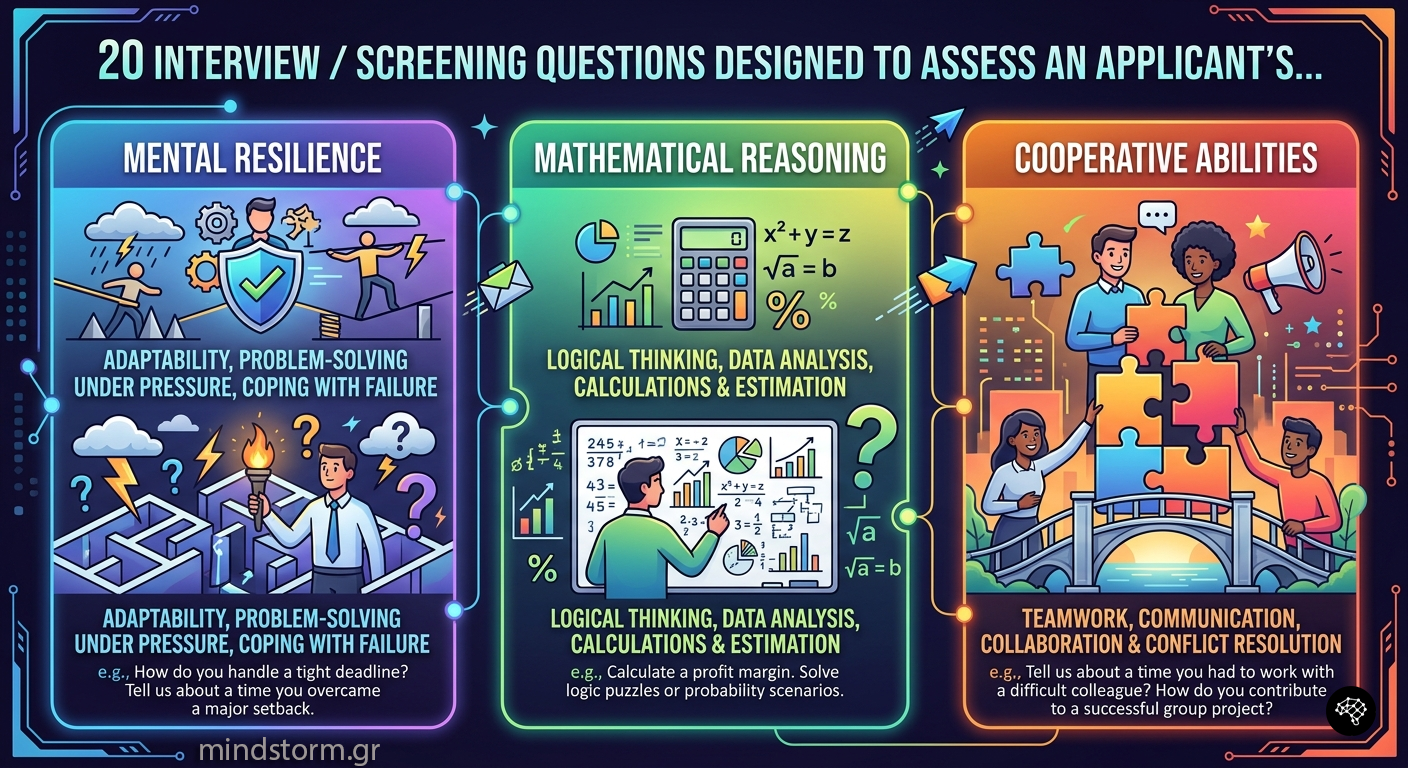
Here are 20 interview/screening questions designed to assess an applicant’s mental resilience, mathematical reasoning, and cooperative abilities. They are categorized for clarity, mixing multiple-choice (MCQ) and open-ended formats to help you gauge different types of skills.
Section A: Mental Factors (Cognitive Agility & Stress)
These questions assess adaptability, learning speed, and emotional regulation.
- [Open-Ended] Describe a time you had to learn a complex new skill or software very quickly to meet a tight deadline. How did you approach the learning curve?
- [Multiple Choice] When you receive feedback that contradicts your self-assessment of a project, what is your immediate reaction?
* A) I ignore it to maintain confidence.
* B) I ask clarifying questions to understand the perspective before revising my approach.
* C) I argue my point of view until they agree.
* D) I accept it without questioning it, even if I feel wrong.
(Best practice: B) - [Open-Ended] Imagine you have a critical deadline and a major unexpected technical error occurs. How do you manage your stress and prioritize tasks?
- [Multiple Choice] Which statement best describes your approach to making a decision when you have incomplete information?
* A) I wait until I have 100% of the data to avoid risk.
* B) I make the best decision possible with current data and adjust as we learn.
* C) I ask my manager to delay the decision until everyone is ready.
* D) I guess the most likely outcome and move on.
(Best practice: B) - [Open-Ended] Give an example of a mental block or “imposter syndrome” moment you experienced. How did you overcome it?
- [Multiple Choice] When faced with two competing tasks of equal importance, which factor do you prioritize most?
* A) Which task is more urgent.
* B) Which task makes me feel happier.
* C) Which task involves more team members.
* D) The one with the smallest scope.
(Best practice: A or B, depending on company culture) - [Open-Ended] How do you ensure you don’t overlook small details when you are under significant pressure to perform mentally?
Section B: Mathematical & Analytical Reasoning
These questions test numerical literacy, logical thinking, and data interpretation.
- [Multiple Choice] A company has 100 units of stock. Orders come in for 20, 15, and 30 units in three different weeks. In which week did they sell the highest percentage of total stock?
* A) Week 1 (20% of 100)
* B) Week 2 (15% of 80)
* C) Week 3 (30% of 65)
* D) They all sold the same percentage.
(Answer: A) - [Open-Ended] If a machine takes 5 hours to build a part, how long will it take 5 machines to build 5 parts? (Test understanding of parallel processing vs. multiplication).
- [Multiple Choice] You are analyzing a sales graph. The line goes up, then flat, then up sharply. If you had to predict the next quarter based only on this trend, what would you advise?
* A) Stop selling immediately to avoid overstocking.
* B) Slow down sales during the “flat” period.
* C) Prepare to scale resources for a potential rapid increase.
* D) Ignore the graph.
(Best practice: C) - [Open-Ended] Explain the math or logic behind how you calculate the return on investment (ROI) for a marketing campaign you managed last year.
- [Multiple Choice] In a logic puzzle: All “Bears” are “Blue.” Some “Blue” things are “Round.” If a “Bear” is found, which is true?
* A) The Bear is definitely Round.
* B) The Bear is definitely not Round.
* C) The Bear might be Round.
* D) None of the above.
(Best practice: C) - [Open-Ended] Estimate the number of people in this room without counting them. Show me your thought process for reaching that number.
- [Multiple Choice] A project is 25% complete. It was supposed to take 10 days, but the deadline is now 12 days away. What is your status?
* A) Behind schedule.
* B) Ahead of schedule.
* C) On time.
* D) Impossible to determine.
(Answer: A)The key to this question is comparing planned progress vs actual progress in time.
🔹 Step 1: What was the original plan?
- Total duration: 10 days
- So expected progress rate:
👉 10% per day
🔹 Step 2: Where should you be today?
We’re told:
- The deadline is now 12 days away
That means:
👉 You are at day 0 of a 12-day timeline? Not quite — this is the tricky part.Interpretation:
- Originally: finish in 10 days
- Now: you still have 12 days left → schedule has slipped or you’re early in timeline
But what’s important is this:
👉 If you’re 25% complete, how much time should that have taken?
🔹 Step 3: Planned vs actual progress
Planned:
- 25% of work = 2.5 days (since 25% of 10 days)
Reality:
- You have 12 days remaining, meaning you’re still very early relative to total time available
🔹 The core insight
If you’re only 25% done, but you still have more time left (12 days) than the entire original project duration (10 days):
👉 That means you’ve used time inefficiently relative to progress.
You should have progressed faster relative to the available time window.
🔹 Simple intuition
Think of it like this:
- You planned: “I’ll finish in 10 days”
- Now: “I still need 12 days to finish”
👉 That means:
You are slower than planned → Behind schedule
🔹 Final Answer:
✅ A) Behind schedule
- [Open-Ended] If you had a spreadsheet with 5000 rows, how would you find the error if a specific calculation kept coming up wrong but the numbers looked fine?
- [Multiple Choice] Which of these three scenarios represents a “risk” in a business context?
* A) Losing 10% of revenue if you don’t act.
* B) Gaining 5% revenue.
* C) Maintaining 0% revenue.
* D) A guaranteed profit.
(Best practice: A or C depending on context)This question is testing whether you understand what a “risk” actually means in business—not just something negative, but something uncertain that can affect outcomes.
🔹 What is a “risk” (correct definition)?
In business/project management:
Risk = an uncertain event or condition that can have a positive or negative impact
Two key elements:
- Uncertainty (it may or may not happen)
- Impact (positive or negative)
🔹 Evaluate each option
A) Losing 10% of revenue if you don’t act
👉 This is a classic negative risk (threat)
- It’s not guaranteed
- It depends on whether you act or not
- It has a negative impact
✅ This is definitely a risk
B) Gaining 5% revenue
👉 This could be a positive risk (opportunity)
BUT:
- It sounds more like an outcome than an uncertain event
- No condition or uncertainty is clearly stated
⚠️ So it’s not clearly framed as a risk, just a result
C) Maintaining 0% revenue
👉 This depends on interpretation:
- If it means “there is a possibility revenue won’t grow” → uncertainty exists
✅ Then it can be a risk (stagnation risk) - If it means “revenue will stay the same for sure”
❌ Then it’s not a risk (no uncertainty)
👉 That’s why the answer says:
“A or C depending on context”
D) A guaranteed profit
👉 This is the easiest one:
- “Guaranteed” = no uncertainty
❌ Therefore, NOT a risk
🔹 Why A is the safest answer
Because it clearly includes:
- Uncertainty
- Negative impact
- Conditionality (“if you don’t act”)
👉 It fits the definition perfectly.
🔥 Key takeaway
A situation is a risk ONLY if:
- It might happen (uncertain)
- It will affect your objectives (impact)
🔹 Quick mental rule for exams
Ask yourself:
👉 “Is this uncertain?”- YES → Risk
- NO → Not a risk
Section C: Cooperation & Team Dynamics
These questions assess conflict resolution, empathy, and the ability to work in groups.
- [Open-Ended] Describe a time you had to disagree with a team member on a solution. How did you communicate the disagreement without damaging the relationship?
- [Multiple Choice] Your team is missing a critical project milestone. One teammate is to blame, but the deadline cannot be moved. What is your course of action?
* A) Let them suffer the consequences and do the work yourself.
* B) Ignore the issue and hope it passes.
* C) Discuss the issue with the teammate privately to find a solution before escalating to management.
* D) Immediately report them to management.
(Best practice: C) - [Open-Ended] If you were leading a diverse team with members from different backgrounds, how would you ensure everyone feels heard and valued?
- [Multiple Choice] Which of the following best defines a “healthy” team dynamic?
* A) Everyone agrees on everything all the time.
* B) High trust, psychological safety, and constructive disagreement.
* C) One loud leader tells everyone what to do.
* D) Team members never talk to each other.
(Best practice: B)
Tips for Using These Questions:
- Review Answers: For open-ended questions, do not just look for the “right” answer. Look for reasoning. Does their process make sense? Did they consider risks?
- Follow Up: Use the multiple-choice answers as a prompt for conversation. “You chose C, why is that your preference?”
- Context: Always clarify the job level. For senior roles, expect deeper strategic answers in the math/mental sections; for junior roles, focus more on foundational calculation and willingness to learn.
—
Here is a guide to the Best Practices for each question.
This guide is designed to explain why an interviewer asks the question (to help the hiring manager understand what to look for) and how an employee should frame their answer (to help candidates prepare effectively).
Category A: Mental Factors & Cognitive Agility
- Learning a Complex Skill (Open-Ended)
- The Intent: To measure learning agility and humility.
- Ideal Answer Approach: Don’t just say “I studied.” Mention how you broke the skill down, who you asked for help from, and how quickly you applied it.
- Candidate Tip: Use the STAR method (Situation, Task, Action, Result). Example: “I broke the software into modules, used online documentation for Module A, and asked a mentor for Module B, finishing within 48 hours.”
- Reaction to Contradictory Feedback (Multiple Choice)
- The Intent: To screen out ego-centric employees.
- Ideal Answer Approach: Choose the option that shows curiosity and growth. Never choose “Ignore” or “Argue.”
- Candidate Tip: Even if you chose B in the test, explain in the interview that you want to understand the context of the feedback before changing your course.
- Managing Stress & Technical Errors (Open-Ended)
- The Intent: To see if you panic or stay grounded.
- Ideal Answer Approach: Describe a specific moment you felt pressure. Admit feeling the pressure (it shows authenticity) but pivot immediately to the solution.
- Candidate Tip: Use phrases like “I prioritized the critical path first” or “I isolated the variable causing the error” rather than just “I stayed calm.”
- Decision Making with Incomplete Info (Multiple Choice)
- The Intent: To test risk tolerance and logic.
- Ideal Answer Approach: Awaiting 100% data is usually impossible in business. The “Best Practice” answer is to make the best decision with current data while flagging the risk.
- Candidate Tip: If you choose “A” (wait for data), be prepared to explain how you handle delays. If you choose “B” (move forward), explain your risk mitigation plan.
- Overcoming Imposter Syndrome (Open-Ended)
- The Intent: To check for self-awareness and resilience.
- Ideal Answer Approach: It is better to admit you have felt this than to deny it. Admitting it makes you human; explaining how you handled it makes you employable.
- Candidate Tip: Talk about a specific “small win” you recorded to prove your competence later.
- Prioritization Between Competing Tasks (Multiple Choice)
- The Intent: To see if you value impact over feelings.
- Ideal Answer Approach: Prioritizing based on “Urgency vs. Importance” is the standard business practice. However, prioritizing based on “Team Impact” is good if the role requires collaboration.
- Candidate Tip: Explain that you look at which task has the highest impact on the business deadline.
- Maintaining Detail Under Pressure (Open-Ended)
- The Intent: To see if you use process controls (checklists, etc.).
- Ideal Answer Approach: Do not say “I focus.” Say “I use a checklist” or “I do a quick peer review.”
- Candidate Tip: Mention that you write down critical details immediately upon receiving them to avoid memory errors.
- Calculating Stock Share Percent (Math)
- The Intent: To measure basic arithmetic and percentage logic.
- Ideal Answer Approach: Show the work. If represents 1% and represents %, calculate .
- Candidate Tip: For this specific question, ensure you know how to calculate percentage change or ratio logic ().
- Machine Work Time Comparison (Math)
- The Intent: To test understanding of parallel work or rates.
- Ideal Answer Approach: If one machine takes time, does the second take or ?
- Candidate Tip: Use simple fractions. If Machine A takes 10 mins, Machine B (1.5 hours = 90 mins) is 9 times slower. If the question asks about combined time, add rates ().
- Interpreting Graph Trends (Math)
- The Intent: To test data interpretation.
- Ideal Answer Approach: Look for the steepest slope or the most recent data point. Ask “What is the trend implying?”
- Candidate Tip: Always mention the time frame (e.g., “Over the last quarter, sales dropped by X% due to Y”).
- Calculating ROI/Profitability (Math)
- The Intent: To test business math ().
- Ideal Answer Approach: Ensure you distinguish between “Revenue” and “Net Profit.”
- Candidate Tip: If a question asks for “Gain,” subtract Cost from Revenue. If it asks for “Percentage Gain,” divide Gain by Cost.
- Logical Deduction (Animals/Logic)
- The Intent: To test deductive reasoning (Bear Logic).
- Ideal Answer Approach: Focus on the premise, not the animal. “All animals in this group are mammals.”
- Candidate Tip: Identify the “odd one out” based on the rules given in the prompt, not common knowledge.
- Estimation Calculation (Math)
- The Intent: To test mental math and ability to estimate quickly.
- Ideal Answer Approach: Round numbers to make math easy (e.g., ).
- Candidate Tip: If a question asks “How many people?”, use multiplication logic () rather than counting every single person.
- Project Completion Percentage (Math)
- The Intent: To check accuracy and progress tracking.
- Ideal Answer Approach: Use the data provided (). Don’t overestimate or underestimate.
- Candidate Tip: In real work, if a task is 50% done, you might report 80% if it’s complex, but in a test, stick to the data.
- Debugging Process (Open-Ended)
- The Intent: To check for technical problem-solving skills.
- Ideal Answer Approach: Describe your method. “I check the code logs first, then the user input.”
- Candidate Tip: Mention using software tools (like Git, Error Logs, or System Monitors) to locate the issue.
- Risk Context Awareness (Multiple Choice)
- The Intent: To measure risk awareness.
- Ideal Answer Approach: The “Risk” is often hidden in the options (e.g., “High probability of failure”).
- Candidate Tip: Always look for the answer that includes “Mitigation” or “Assessment” rather than just “Proceed.”
Category B: Cooperation & Teamwork
- Handling Disagreement (Open-Ended)
- The Intent: To see if you can handle conflict professionally.
- Ideal Answer Approach: Focus on the solution, not the person. “We debated the best path to achieve X goal.”
- Candidate Tip: Avoid saying “I won the argument.” Say “We reached a consensus.”
- Addressing Team Failure (Open-Ended)
- The Intent: To check accountability and growth mindset.
- Ideal Answer Approach: Do not blame others. Acknowledge your part. “I missed the deadline, which caused the delay.”
- Candidate Tip: Follow up immediately with “However, we fixed it by X.” Focus on the recovery.
- Working with Diverse Teams (Open-Ended)
- The Intent: To check cultural intelligence and inclusion.
- Ideal Answer Approach: Mention how you adapt your communication style to the team.
- Candidate Tip: Use phrases like “I listen actively to understand different perspectives” or “I ensure everyone feels heard.”
- Healthy Team Dynamics (Multiple Choice)
- The Intent: To screen for “toxic” or “passive” candidates.
- Ideal Answer Approach: Choose the option that promotes “Psychological Safety.”
- Candidate Tip: If you choose “A” (Silence), explain that sometimes silence means “we are comfortable.” However, the “Best” answer is usually about “Trust” and “Open Communication.”
—
How to Present This
If you are showing this to candidates (employees):
- Share the “Intent”: This makes them confident. They aren’t being asked trick questions; they are being asked about their mindset.
- Use the “STAR” for open questions: Remind them to always have a real-life story ready, not just a theoretical answer.
- For Math/Logic questions: Emphasize showing their work. Even if the answer is wrong, the process of showing the calculation demonstrates their logic.
Summary for the Hiring Manager
- Mental Factors: We value adaptability over perfection. We want to see you admit mistakes (Q2, Q5).
- Math/Logic: We value accuracy over speed. Show your work (Q8, Q9, Q11).
- Cooperation: We value safety over ego. We want to see you admit faults (Q18) and listen to others (Q19).
This guide provides a “Cheat Sheet” for the hiring process, ensuring transparency and reducing anxiety for applicants.


Comments are closed.